Gypsies and Tom Hyer
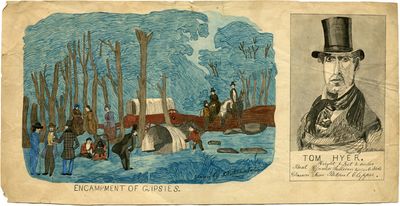

“Encampment of Gipsies”
As early as the mid-1700s, some Roma families sought a better life in the American colonies, often by agreeing to indentured servitude in exchange for passage by ship. Many German Gypsies settled along the Conestoga Creek in Lancaster County, Pennsylvania (later southern Berks County), which retained one of the larger German Gypsy populations into modern times. They were generally skilled artisans (metallurgy and willow basket weaving) and horse breeders, of a caliber unequaled in southeastern Pennsylvania.
“Tom Hyer, Height 6 Feet 2 Inches, Beat Yankee Sullivan 5,000 A Side, Drawn From Pictorial Clipper.”
Boxing was a hugely popular sport during the nineteenth century, particularly among recent immigrants and members of the working class. Fights were illegal in most states but by no means uncommon.
On February 7, 1849, one of the most famous prizefights of the century took place in the backwoods of Maryland. New York-born Tom “Young American” Hyer challenged reigning United States champion James “Yankee” Sullivan at Still Pond, about eight miles from Chestertown. An Irish immigrant, Sullivan had waited two years for this match; a punishing fighter, he had difficulty finding opponents. The match with Hyer, for an unheard-of $10,000 winner's purse, was arranged in part by boxing fans with nativist sentiments who wanted to replace Sullivan with an American-born champion. After sixteen half-minute rounds, Sullivan, shorter and lighter in weight than Hyer, suffered the first defeat of his career.